
Montpellier, July 22, 2018
From Arcachon, I took the train into Bordeaux.
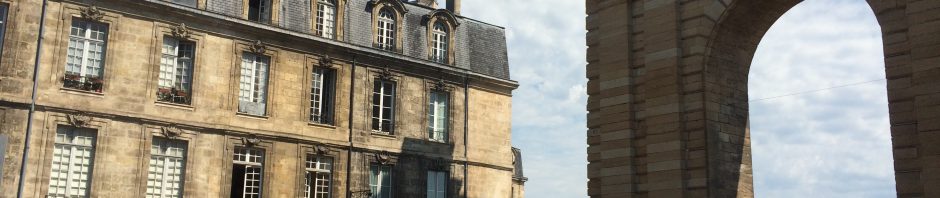
After the importance and elegance of Paris, and the evident, nearly uniform affluence of Arcachon and Pyla, I was initially taken aback. Of course, Bordeaux is much smaller than Paris, but much of it is also run down. My first walk, from the St. Jean train station, was through a busy area of very old, two story houses, generally in elegant limestone, but not in good shape. Everything looked low rise and small. Even at the center of the city, the buildings have no more than 4-5 stories, and in many other areas, there are houses, shops and streets that are too neglected to be charming. The vaunted St. Catherine Street consists largely seedy and generic shops, drawing tourists and poor immigrants.
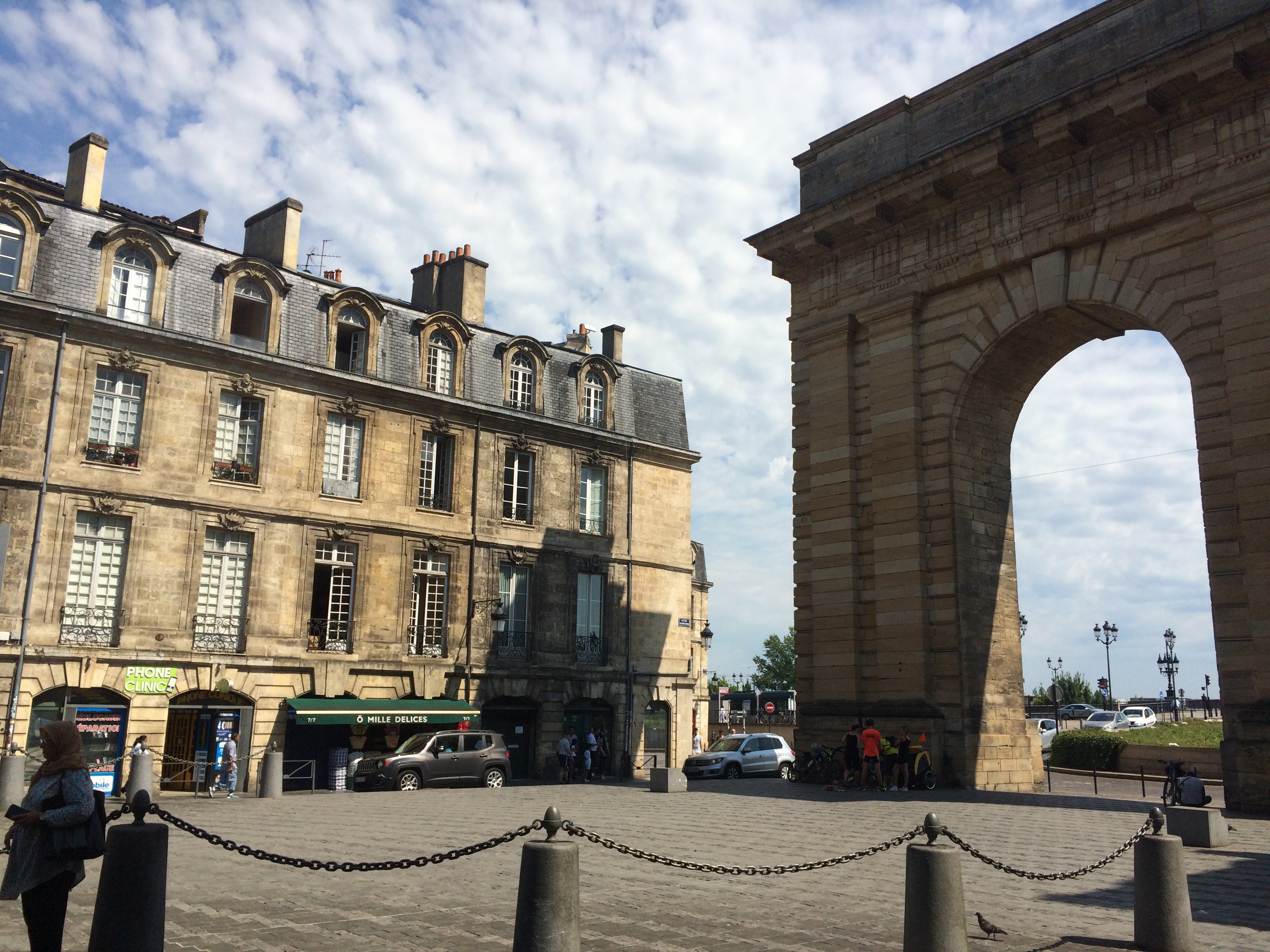
Place de la Victoire
This is not what was emphasized in the reading before my arrival. Queen Elizabeth herself described Bordeaux as elegant. The historic city has been largely redone. Its classical buildings are among the finest in Europe, and its historic district, which appears to include the entire center city, is a UNESCO world heritage site, the second largest in France (after Paris). Its history and wealth are fortunately tied to the wine trade–Bordeaux vineyards are north, south and east of it—and unfortunately to the slave trade, although in the latter it is not unique. For some hundreds of years, Bordeaux was an English possession, although the English rulers at that time spoke in French. The trade in “claret” has strong links to England, as shipping wine by boat to England and Holland (where it was made into spirits) was easier than shipping it overland in France. More than in the rest of France, I was told, the bordelais like clairet (between a red wine and a rose) and tea.
But the city has a cultural importance that held my expectations, and it improved vastly with the visit. Indeed, within a few days I had found and was converted to its incredible beauty, both where it has and has not been fixed up, now fully convinced that a highly-evolved urbanity can exist in a city that is both relatively small and affordable.
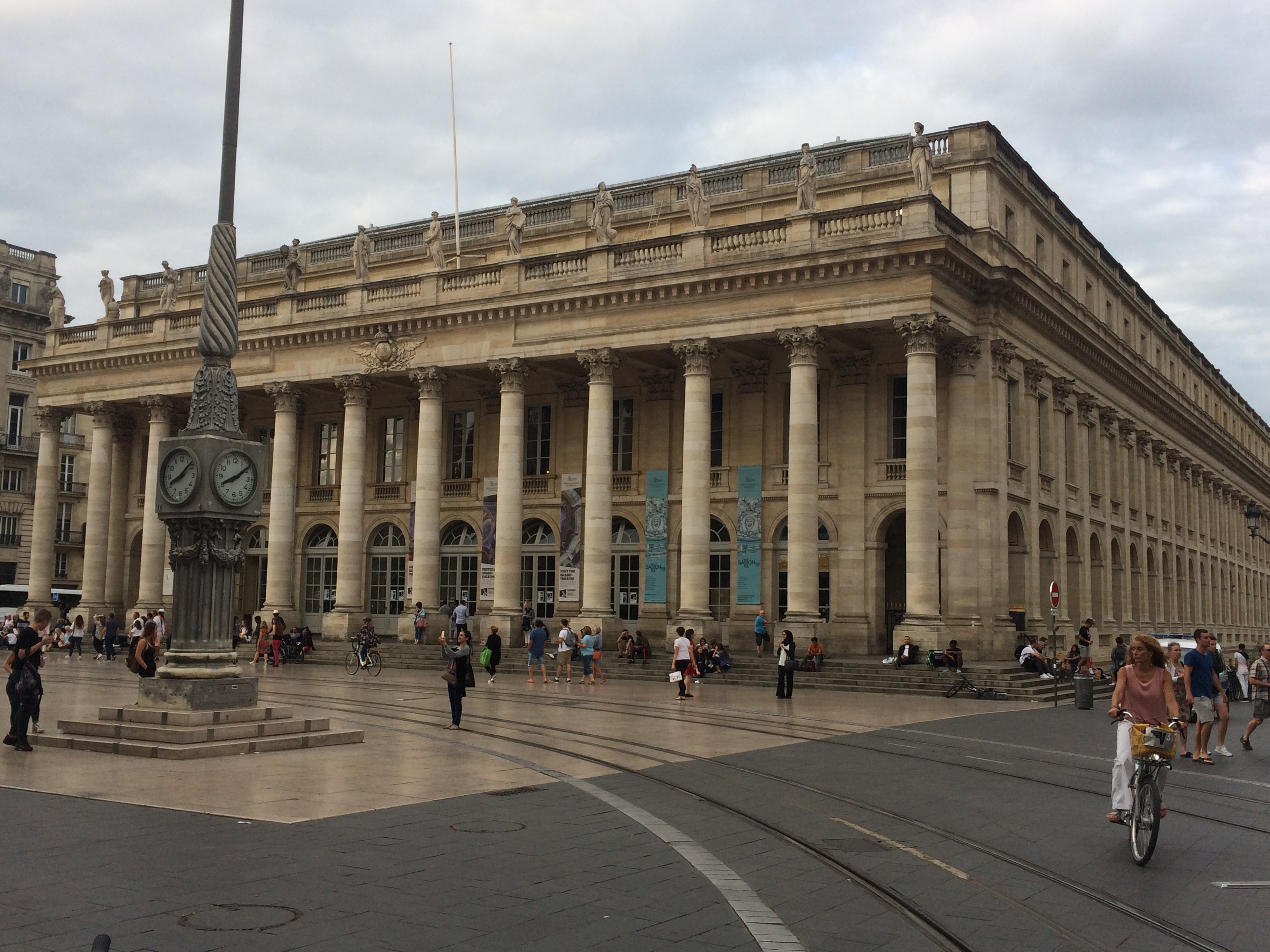
Le Grand Theatre
Bordeaux is a city of endless, classical, limestone facades, gracing the housing of both the rich and the poor, the native-born and the immigrant, and providing a varied yet consistent backdrop to government buildings, the public garden, traffic circles and irregular church “squares”. None of it has been over-renovated—it all looks and feels old. The buildings, dating from the 17th, 18th and even 19th century, are mostly contextual, that is modest, with occasional flourishes, all in limestone, respectful in scale.

The city is busy with traffic, much of it from small cars, visible everywhere except in the large pedestrian area at the city’s center, yet unlike well-preserved Boston, it not overwhelmed by its considerable traffic—most of the streets are simply too narrow. The whole thing is tied together by a bus network, which I never figured out, and by a modern, futurist, tram system, that floats slowly on the streets, tracks embedded in the stone and cobblestones that it shares with cars, and even with pedestrians on the main central square that faces the Grand Theatre.
The buildings, even the largest and grandest, are intimate, no more than 5 or 6 stories. Many are one-family houses. Cafe’s, bakeries, grocers, and luxurious stores such as JM Weston (the shoemaker), Figaret (the shirtmaker) and iconic Hermes (which epitomizes luxury by selling nothing that is absolutely needed), are all graced with classical facades. Even the 50-meter public swimming pool on the rue Judaique, which dates from the 1930’s, with a modern glass curtain wall, sundeck, and 1970’s concrete dressing rooms, is set behind an 18th century limestone gate, perhaps the former entrance to a park or an aristocratic residence, known in France, as an høtel. (Sorry, I cannot get my mac to type the circumflex).
Does it lack individuality? Perhaps, if you are an architect or developer seeking creativity, or a land owner who would prefer to speculate on land acquisition to maximize profit. All of these buildings are protected, and changes are supervised by the French administration. But if you are walking in it, shopping in it, rushing home in it, sitting in a café or on a bench, or watching people in the street, it feels immensely urbane and human. I have not yet found out where Bordeaux houses its high tech or aeronautics facilities, perhaps outside of the city center (a later topic), but I saw discreet signs for law offices and banks, and less discreet windows for neighborhood real estate agencies, restaurants, confectioners and pastry shops (so many of them), grocers and cafes everywhere. The center remains active, much more than a tourist destination, although there were many of us, filled with people going about their business. This is not at all how I remember the centers of Lyons or Toulouse, and that is not my first impression of Montpellier, but that will be checked on my visits to those cities.
In much wealthier New York, we house the poor in 19th century brick walk-ups, with some limestone trim (Why we preserve these, I have no idea.) or in faceless brick high rises, which also house the rich and the middle class. Glass elegance we have, but limestone is mostly limited to the first two floors, even on very good Manhattan buildings. (There are of course a few exceptions such as 740 Park or 19 East 72nd Street.) When a highrise condominium, 15 Central Park West, was built and clad in limestone, its use was a social and architectural tool, and a marketing statement that attracted significant press attention.
So in Bordeaux, a much poorer place than New York, I walked a huge UNESCO heritage site and a city of seemingly endless, modest, luxury. To what can I compare this in the United States? And I do not mean the age, rather the feel. To a significant degree, we mistreat our older cities, either overbuilding and overpricing them to ruin, or destroying them through neglect. Privileged Americans, we travel here to admire what we refuse to preserve or create at home.

behind the basilique St. Seurin
I had a wonderful afternoon in the center of old Bordeaux: a meeting at the Grand Hotel, facing the Grand Theatre, chocolates in an elaborately old-fashioned shop around the corner, coffee at the attractive and hip Alchemist, food shopping at the round and covered marketplace Grands Hommes, and tea, from Mariage Freres (founded in 1854). Then peeks into a couple of hotel lobbies that were a lot nicer than mine—to one of which I eventually moved. And of course, a renaissance church and a lot of cleaned up, beautifully maintained, limestone buildings. Then a swim in that Olympic-sized pool on the rue Judaique, and a long pleasant walk past crowded trams, to my hotel, interrupted by a brief unplanned stop into an organ recital at the Cathedrale St. Andre. And then a nap and bread and cheese and fruit from the nearby Capucins market.
On another afternoon, I strolled through old residential neighborhoods in Saint Michel, Saint Paul and Saint Pierre, where tightly woven streets alternate with open squares and some wider avenues. The buildings, still limestone, are alternately tired and redone. The population looks settled and local, immigrants and young, somewhat multiracial, North African and French, a comfortable place for me. I found a classic, charming bistro facing the St. Michel basilica, and returned that evening for a classic, although mediocre, meal.
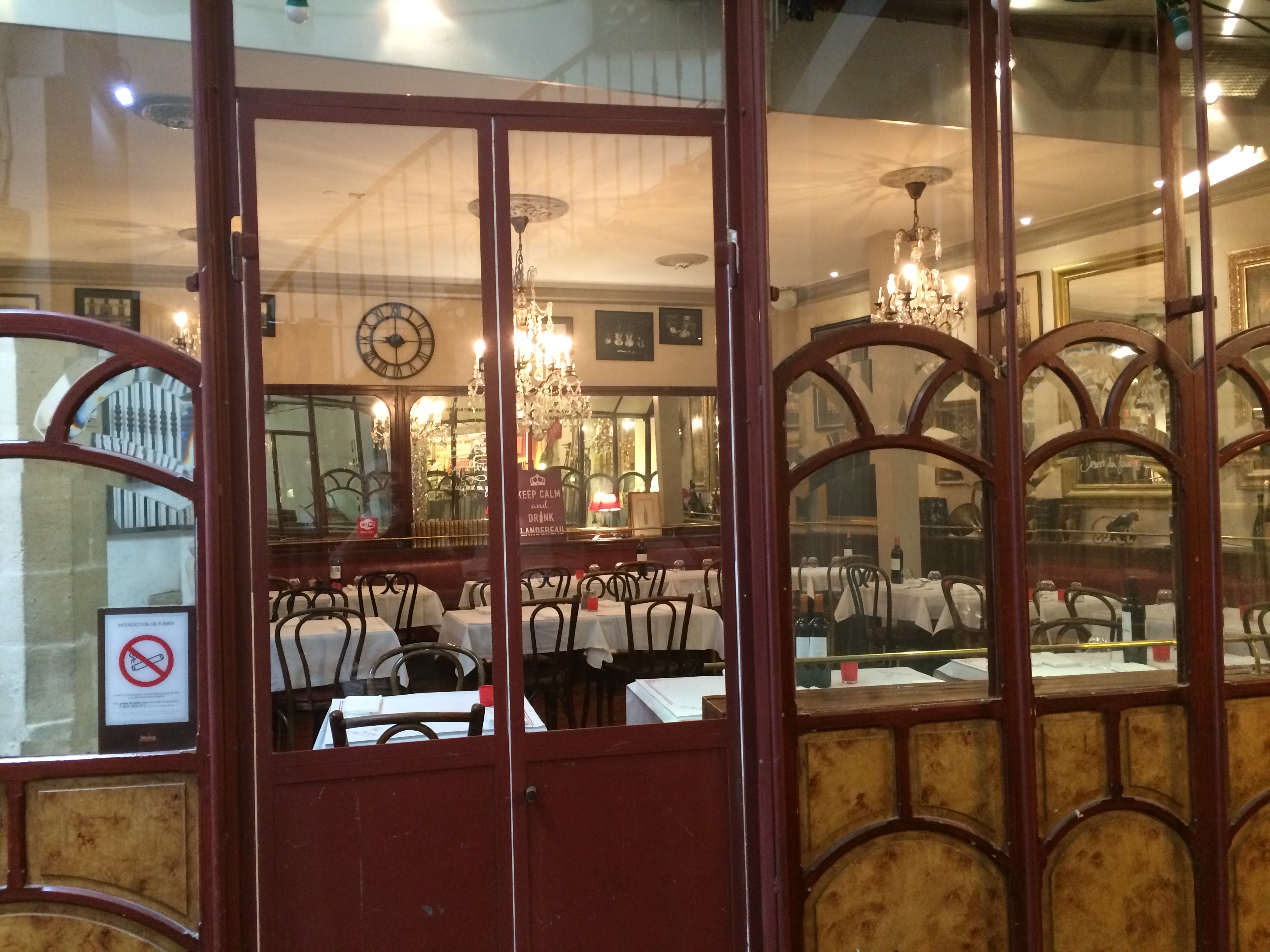
restaurant in the St. Michel district
Have I mentioned the wine culture in Bordeaux? I had only a small taste of it, but as a northern Californian, and former San Francisco resident, I could not help reacting to the similarities and to the differences. San Francisco is to Napa and Sonoma as Bordeaux is to, well Bordeaux wines. San Francisco is a stunningly beautiful city, and it has the considerable advantage of extraordinary geography, but it has the considerable disadvantage of being hugely expensive. Bordeaux offers the refinements of its classical design and its history, in a less dramatic geographical setting, and its ancient wine culture struck me, ironically given its US reputation, as more affordable and accessible. I took a very good, short wine tasting class at the striking new wine museum, the Cite des Vins. The teacher’s detailed knowledge was impressive and without any of the ordinary and usual references to the important celebrities who consume or made them. It was just about the wine. Then I visited a second museum in the Chatrons district, which examines the history of the wine trade. And on my last evening, a visit to the Bar a Vin, a wine café, in an eclectically redesigned classical interior. Operated by the Bordeaux Wine Council, and crowded in the evenings, I waited my turn to try interesting, if not the very best wines, at 3 or 4 euros a glass (with cheese or charcuterie).

Bar a Vin, behind the bar
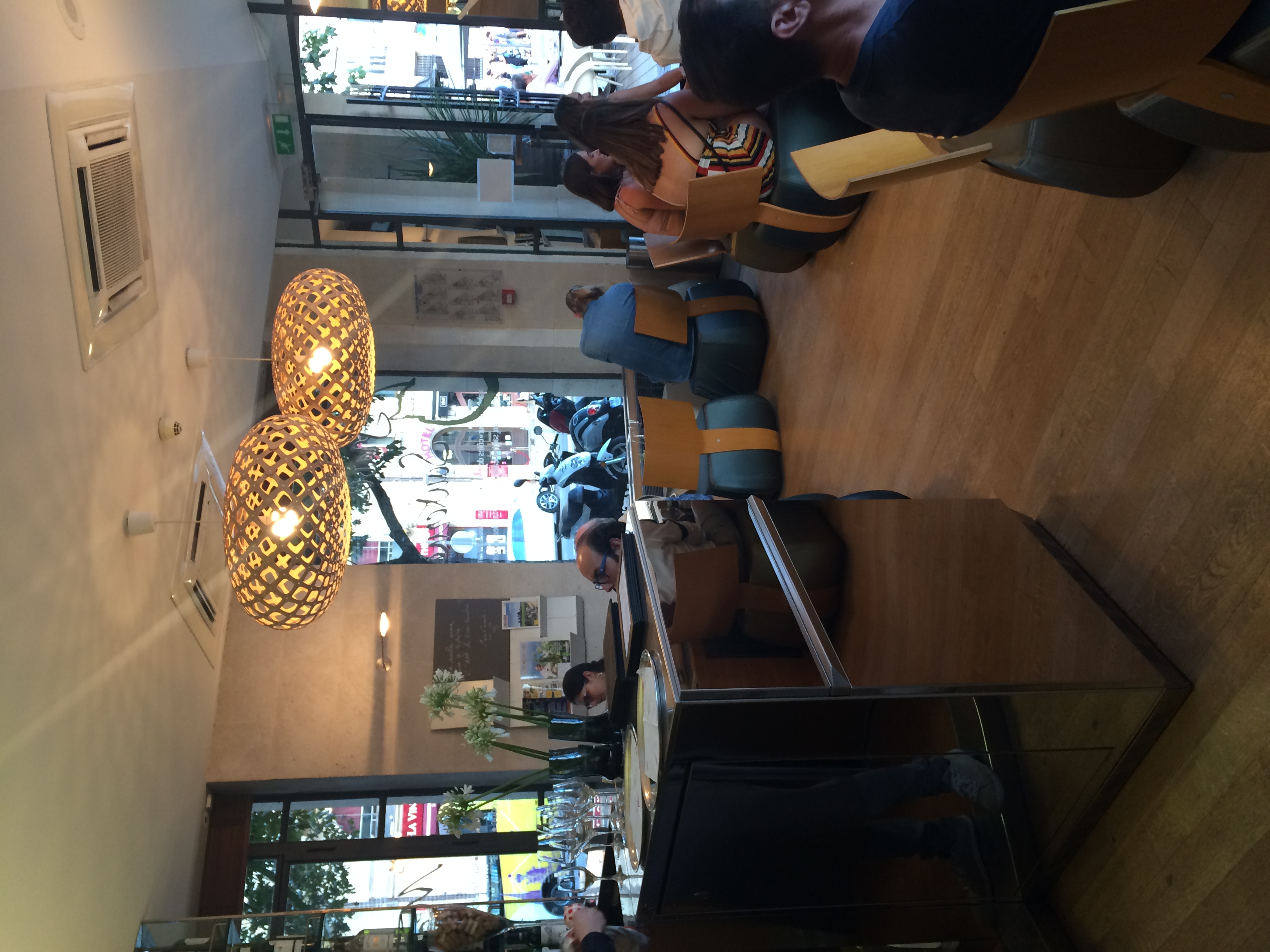
Bar a Vin
On an earlier morning, I returned to the Capucins market for a coffee, and entered into a long conversation, with a friendly, chic, Parisian woman, who followed a man to Bordeaux four years ago. The man did not work out, she said, but she has kept her small rental house, with two bedrooms, a bathroom, and a small potager, or vegetable garden. The house is large enough for her work studio, where she restores and resells mid-century furniture. Her income is a bit less than it was in Paris, but her expenses much less. The native bordelais are not terribly friendly she told me, so her friends are others who have moved in, also from Paris. I was made to understand, by her and others, that Bordeaux is conservative, and not terribly open to outsiders and immigrants. But with a couple of exceptions, I found everyone to be friendly and helpful, despite my accent and occasional word trouble.






Looking at France’s cities: Montpellier
Montpellier, July 25, 2018
After Bordeaux, I took intercity rail service to Montpellier. The train line passes through Toulouse and continues to Marseilles, but I stopped in Montpellier to see one of the fastest growing metropolitan areas in France.
Its took me a few days to realize that both the city’s future and its present are reflected in the new Sud de France train station. It is a remarkable and impressive structure, and likely big enough to handle future growth. When I left it and found myself, on a Sunday afternoon, at some distance from the center of the city, I was taken aback. This didn’t seem very French. But Montpellier’s France doesn’t look at all like the France of my youth.
the Sud de France train station
There is of course an old Montpellier. It is on a defensible rise, formerly surrounded by walls, and now ringed by roads and streetcar tracks. It is very old, almost medieval (founded in 985), not so much the buildings which mostly date from the 18th and 19th centuries, but the tightly woven and many narrow streets. There are electric lanterns lighting the narrowest of these, and their effect is both helpful and antique.
a narrow street in old Montpellie
The feeling of ancient remove is most marked at the northwestern end of the city, near the Cathedral of St. Pierre and the old medical school which abuts it, and around the Place de la Canourgue, which was its center in the 17th century. The nearby streets are quiet and small, punctuated by open squares and small verdant parks that are closed at night. (I had two wonderful evenings, and then a third, at l’Atelier wine bar on the Pl. de la Carnourge, whose owner Emmanuel Bray, suggested a very good Macon Villages (2017), and then served a very good apricot tart, pairing it stupendously with a white Auslee cuvee (2015), from Austria.)
a window and a waitress on the Place de la Canourge
I have taken again, on this trip, to visiting churches, a deserving European habit because of their frequent beauty and spirituality, and because they are also cultural centers, for art and for music. In the case of St. Pierre, a one-euro donation for church maintenance, as I was leaving, earned me a private tour from an informed volunteer. A large 17th century painting, of a reactive Joseph, awakened by an angel with news of Mary’s pregnancy, was interpreted as his surprise at being told that he was to be the stepfather of the Son of God. And the adjacent hospital, according to the volunteer, was merely housing for the medical students. Classes were held outdoors or in the church. Dissections were held in the nave.
Montpellier is a famous university town, with ancient liberal arts, medical, and law schools, and a large portion of its population is students. The medical school is the world’s oldest in continued operation, its early success due to the liberal policy of the lords of Montpellier, allowing any licensed physician, including Jews, to lecture. The school was immensely prestigious during the middle ages, according to Wikipedia, reputed to have inherited the medical knowledge of the Arabs and the Jews and attracting students from all over Europe.
the cathedral of St. Pierre and the old medical school
The center of old Montpellier has not been extensively redone, but it has been preserved, and museums and cultural institutions have been added. Post 19th century buildings are rare and are generally built at the edges of the old city. But Montpellier has been growing beyond the old city since for well over 100 years.
The great and extensive Place de la Comedie faces an opera house and other 19th century buildings. It is filled with people who are walking through, waiting for the streetcars, sitting in cafes or watching evening acrobatics. Its activity is of little interest to me, but clearly it captivates many others. At its southern end, the place opens to another square, and then transitions from stone to ceramic paving. The newer place is framed by modern, concrete buildings, including shops, perhaps 20 to 30 years old, a very good bookstore, cafes, and an architecturally interesting Ibis Hotel where I am staying. At the end of this square is a very busy, multi-story shopping mall, which has a among others, Galleries Lafayette, Monoprix and a FNAC. Throughout the day and evening, large numbers of people are walking in and out of the mall, across the square, into the Place de la Comedie, or the reverse. Everywhere there are cafés, bakeries and snack bars. These public squares are car free (with parking underneath the mall) and very successful.
La Place de la Comedie
The modern “place”, my Ibis Hotel, and a shopping mall
North of the Place de la Comedie, the pedestrian activity flows into much of the southern portion of the old city. Most of the old city has been closed to vehicular traffic since 2004. At night, the streets and squares are filled with tables and people and restaurants, outdoor cafes and wine bars. Daytime, the stores are for the occasional shopper, juice stands, luxury goods, etc. The old buildings are there, but the street activity is transitory and one-dimensional. It took me some time and street-car travel to realize that the new soul and dynamic of Montpellier have moved outside the old city. Much of the old city has been re-adapted as an entertainment center.
Yesterday, I took a streetcar ride to the Olympic swimming pool in Antigone, a quiet planned neighborhood of large, modernist offices and apartments, built after 1979. The pool, the master plan and most of the buildings were designed by the Spanish architect, Ricardo Bofill. Not the very strikingly modernist pool, but many of the other buildings, are neo-classical, in concrete, with exterior columns, a material that has not held up well and a design that is reminiscent of the 1930’s and Mussolini. The emphasis is on calm, not on street life—I saw few stores, but visible through the doorways of a couple of larger buildings are some very beautiful courtyard gardens. Walking out of the Antigone and back towards the old city, I saw streets, with cars and shops, 19th century buildings with ornate iron balconies, and taller mid-rise, apartments, some attractive, others unfortunate. These were pleasant, normal places, reflecting the character of the 19th-20th century city that lies around the old core.
the Olympic pool in Antigone
an Antigone courtyard garden
leaving Antigone
outside the old city
Montpellier is a formerly provincial city that is pushing well past its 19th century boundaries. I followed the same streetcar line in two directions this afternoon, in the westerly direction to the terminus at Odysseum, and to the northeast, just one stop short of the end of the line at Mosson. Riding west, I saw many new (or no-longer-new) apartment buildings, surrounded by open areas and gardens, within walking distance of streetcar stations, and with roads and parking. At Odysseum, I walked off the tram into a new, two-story shopping area, which reminded me of nothing more than southern California, and specifically, with this week’s dry heat, of Palm Desert, where I visited my parents regularly some years ago. And then, I understood why Montpellier is growing. It is France’s version of the Sun Belt—affordable, modern and with wonderful weather. I spent much of my life running away from California, and here, happily, I felt at home.
the salad place at Odysseum
Of course, it is not the same. This shopping center has sun and outdoor dining, including a very nice salad place where I had lunch, a Burger King and a parking lot (just like California), but its public goods are important and visible, a kitschy outdoor Greek theater (with classical statues and a Mahatma Gandhi), a planetarium and an aquarium, a street car station. But the cars in the lot are smaller. The atmosphere less blatantly affluent. From the train, I saw apartment buildings rather than single family houses. What it does have is the same celebration of good weather and the same feeling of middle class leisure.
the Greek theater at Odysseum
Returning to the center, again by streetcar, I got off at the Port Marianne stop facing a modern building and a Kaufman & Broad showroom, a southern California builder, for whom my father did some consulting engineering work in the 1970’s. I was told that Kaufman & Broad is active all over France. Beyond it, the neighborhood, the open space, and the city hall overlooking the Lez River were strikingly beautiful. While cultivated Frenchmen (including most of my friends) prefer their country houses and elegant, or at least antique, Paris (or Bordeaux) apartments, a sunny style of modern apartment living is better, for many, than old darkened houses on narrow village streets (or carless, narrow, Montpellier streets). There is a reason for suburban living, and Montpellier is producing a higher-density version of it.
a modern city on the Lez River
the new city hall
On the second trip, north and east, I saw again, an older 19th-20th century city, this time with some houses, outside the old city. This gave way again, to newer offices and apartments, less striking than some I had seen on the westerly route. What was impressive, in this direction, was the university and hospital buildings. Montpellier has retained its intellectual tradition, and an Irish passenger next to me confirmed that it is a major medical center. My map shows a number of hospital and university buildings on the north side of the city. This one is apparently brand new.
a new medical building
Only at the outer stops did I see what I had not seen previously. A banlieue of deteriorated contemporary housing, populated almost exclusively by middle eastern immigrants. Elsewhere in the city, everybody appears to mix with ease.